THE CONTENT
Scrambled on the phone
End-to-end encryption turns a message into gibberish on the sender's device, and only the final recipient can decode it. Even the app's servers cannot listen in.
Who can read it? doodlechatapp
HOW CHAT ENCRYPTION WORKS
Your message passes through many computers on its way.
Who can read it?
SEALEDend to end
With end-to-end encryption, it is scrambled on your phone and only unscrambled on the recipient's. The app's own servers pass it along without being able to read it. That is a lot of protection, but not all of it.
Updated
THE SHORT ANSWER
Encryption hides what you said.
It does not always hide that you said it.
THE CONTENT
End-to-end encryption turns a message into gibberish on the sender's device, and only the final recipient can decode it. Even the app's servers cannot listen in.
Who can read it?THE KEYS
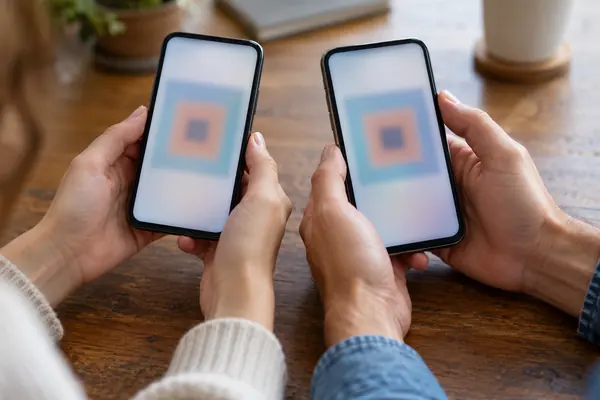
Apps let you compare a fingerprint or scan a QR code to confirm the key belongs to your friend, which guards against a machine-in-the-middle.
How to checkTHE LIMITS
The service may still see when messages are sent and your IP address. Cloud backups need their own encryption to stay protected.
See the numbersA QUICK CHECK
Pick someone along the way to see what end-to-end encryption hides from them. The bar shows how much of the conversation they could still get.
Based on the Electronic Frontier Foundation's Surveillance Self-Defense guides. General information about how the technology works.
TWO NUMBERS WORTH KNOWING
One figure on how many people message online,
one on how big an encrypted group can be.
94–96%
Internet users who send messages or make calls online
Ofcom's 2025 adults' media use report (2024 fieldwork) found 94% of male and 96% of female internet users use sites and apps to send messages or make calls.
UK USE · OFCOM
2 to thousands
Group sizes the MLS standard is built for
The Messaging Layer Security standard, published in July 2023, sets out how a group can agree on encryption keys even when members are not online at the same time.
GROUP CHATS · IETF RFC 9420
RFC 9420 explains that keys are hard to set up for group chats because more than two devices must agree on one, and some may be offline.

FOUR THINGS TO KNOW
These come from how the technology works, not from any one app. Settings differ from app to app.
Transport-layer encryption lets the service see messages on its servers; end-to-end encryption does not.
Compare the fingerprint or scan each other's QR code, ideally in person, to rule out a machine in the middle.
If chats back up to the cloud, check whether those backups are encrypted as well.
Whoever receives a message can screenshot or save it. Encryption protects the journey, not what happens after.
HOW THE KEYS WORK
End-to-end tools rely on public key cryptography. Each person has a public key that can be shared freely and a private key that stays on the device. A message locked with your public key can only be opened with your matching private key.
Modern chat apps swap public keys for you, so there is nothing to set up. The same pair of keys also lets a message be signed, which shows it came from the right person and was not changed on the way.

Questions
A message is encrypted by its original sender and decrypted only by its final recipient. No one in between, including the app's servers, can read it.
Not the content, if the chat is end-to-end encrypted. The EFF notes the company may still collect some metadata, such as when a message was sent and your IP address.
No. HTTPS is transport-layer encryption: it protects data on the way to the service, but the service itself can see the data you send it.
It is a way of checking a public key fingerprint, by comparing characters or scanning a QR code, so you know the key really belongs to the person you are talking to.
No. The EFF says features like disappearing messages can make a chat feel secure without giving the protection you need. Encryption is what stops others reading it.
ABOUT THIS NAME
doodlechatapp.com is part of the DoodleSale portfolio. It isn't in an auction right now, but you can ask about leasing it.